
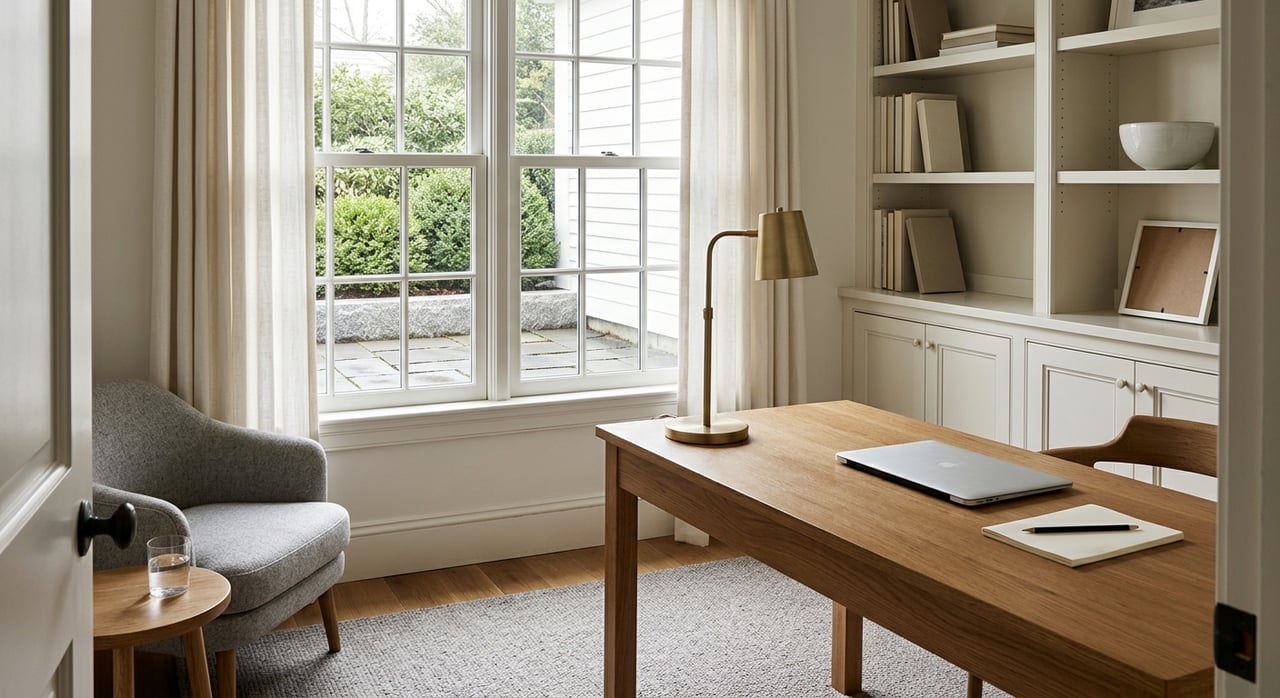
If your workweek no longer fits a five-day commute, where you live starts to matter in a different way. You may need a home that works hard during the day, an easy path into Boston when meetings pop up, and a setting that helps you reset when the laptop closes. In Concord, those pieces come together in a practical way. Here’s how the town supports a hybrid work and home office lifestyle, and what to look for if you’re considering a move.
Why Concord Fits Hybrid Work
Concord offers a strong mix of access, space, and daily livability for people who split time between home and the office. The Town of Concord places the town about 20 miles west of Boston, with MBTA commuter rail service to Boston, Cambridge, and Fitchburg, plus commuter bus service to Boston. Route 2 also connects to Routes 128/95 and 495, which gives you more than one way to manage your week.
That flexibility matters when your schedule changes from day to day. Census QuickFacts reports a mean travel time to work of 32.4 minutes for 2020 through 2024. For many buyers, that points to a commute that can feel very manageable a few times a week, while still making home office comfort a priority.
Homes That Support Work From Home
A hybrid lifestyle often starts with the layout of the home itself. In Concord, the housing stock suggests buyers can find a range of options rather than one narrow style of property. The 2024 ACS table lists the median year structure built as 1997, which supports the idea that the market includes a mix of housing vintages.
That matters because your work-from-home needs may be specific. You may want a dedicated office, a guest room that can double as a Zoom space, or a lower level that gives you separation between work and home life. In many Concord home searches, flexible room use becomes just as important as square footage.
Concord is also strongly owner-occupied. Census QuickFacts shows an owner-occupied housing rate of 75.7% and a median value of owner-occupied homes of $1,210,000 for 2020 through 2024. In a market like this, buyers often focus on long-term livability, which includes office-ready spaces, storage, privacy, and comfortable everyday flow.
Broadband Is a Real Strength
For hybrid work, internet access is not a luxury. It is basic infrastructure. Concord stands out here, with Census QuickFacts reporting that 98.6% of households have a computer and 98.6% have a broadband internet subscription.
That is one of the clearest local signs that remote work is practical in town. Even so, it is still smart to check service, speed, and wiring at the property level before you buy. If your work depends on video calls, large file transfers, or multiple people working from home at once, those details can make a real difference.
Concord Center and West Concord Convenience
If you expect regular trips into Boston, location within Concord matters. The Town of Concord notes that there are two commuter rail stations in town, and it provides parking information for both West Concord and Concord Center, including resident permits and daily fees for outside commuters. That makes these areas especially practical for buyers who want simpler train access.
Homes near Concord Center or West Concord can be a strong fit if your hybrid routine includes frequent office days, client meetings, or dinner plans in the city after work. You may be able to reduce drive time to the station and simplify the overall rhythm of your week. For many busy professionals, that convenience can outweigh the tradeoff of being closer to town activity.
More Privacy Farther From the Stations
Not every hybrid buyer wants to be near the rail stops. If your office days are occasional and your work-from-home environment matters more than train convenience, a different part of Concord may fit better. Homes farther from the stations may appeal to buyers who prioritize privacy, quieter surroundings, or larger lots.
That can be especially helpful if you take frequent calls, need creative focus, or want separation from busier town-center activity. In those cases, your ideal hybrid setup may be less about shaving a few minutes off the commute and more about creating a calm daily workspace.
Commute Options Beyond the Train
Concord supports more than one commuting pattern. The town’s transit information includes commuter bus service to Boston, along with other shared-ride options and local transportation resources. The broader transportation approach also emphasizes walk, bike, and transit connections rather than relying on a single-car-only routine.
That gives you flexibility when your week changes. You might take the train one day, drive another, or combine errands and local trips without always needing the same plan. For hybrid workers, that kind of backup can make everyday logistics feel easier.
Easy Reset Breaks During the Day
One of the biggest benefits of hybrid living is what happens between meetings. Concord makes it easier to step away from your screen and return refreshed. The Town of Concord highlights Concord Center attractions within walking distance, including the Concord Museum, Emerson House, Minute Man National Historical Park, the Old Manse, Old North Bridge, Orchard House, and Sleepy Hollow Cemetery, with Walden Pond nearby.
That means a midday break can be more than a quick walk around the block. If you work from home in Concord, your reset might include a short stroll through town, a visit to a historic site area, or a quiet walk that helps clear your head before the next task.
Trails and Open Space Add Daily Value
Concord’s outdoor access is a major part of its hybrid-work appeal. Minute Man National Historical Park describes itself as a linear park of 1,038 acres across four units, with Concord access points including the North Bridge Visitor Center. Great Meadows National Wildlife Refuge says its Concord Unit includes trails through grasslands, forest, wetlands, and along the Concord River.
In practical terms, that gives you real options for movement and downtime close to home. A break can feel like an actual change of scene, not just a pause indoors. For many buyers, that quality of life becomes part of the value equation when comparing Concord with more urban living.
Bike and Walk Options Support Routine
Concord also supports an active local routine in simple ways. The town says bike-share stations are located at the Concord Visitor Center and at the West Concord entrance to the Bruce Freeman Rail Trail. It also notes that the Bruce Freeman Rail Trail and Reformatory Branch Trail connect into a broader network of dedicated cycling and pedestrian paths from Concord to Boston and Concord to Lowell.
If you like to build movement into your day, that can be a meaningful advantage. A quick ride before work, a lunchtime walk, or an after-work outing can be easier to fit into your schedule when the town’s infrastructure supports it.
Backup Workspace Options in Town
Even the best home office setup has days when you need a change of scenery. The Concord Free Public Library can help with that. Its policies state that study rooms are available for quiet study or small-group work, and that power and wireless internet access are available in all rooms unless otherwise noted.
The library also lends Wi-Fi hotspots, which is a useful practical detail. The key limit is that study rooms may not be used for commercial purposes except tutoring, so they are best thought of as a temporary quiet workspace rather than a full-time office solution. Still, for a focused afternoon or a backup plan, it is a helpful local resource.
What to Look For in a Concord Home
If you are searching for a home that supports hybrid work, it helps to look beyond the obvious. Price, style, and size matter, but day-to-day function matters too. In Concord, a smart search often includes questions like these:
- Is there a true office, or at least a room that can work as one?
- How easy is it to reach Concord Center or West Concord station?
- If you drive to the train, what will parking look like?
- Does the home’s internet setup fit your work needs?
- Do you want to be closer to town amenities or farther out for privacy?
- Would nearby trails, open space, or walkable errands improve your routine?
Those answers can shape how your week feels long after move-in day. A home that looks great online may not always support the rhythm of your actual schedule.
Why This Matters for Buyers
Hybrid work has changed what many buyers value. You may need fewer commute days, but you also need better performance from the home itself. In Concord, the combination of strong broadband adoption, commuter rail access, multiple transportation options, and meaningful outdoor amenities creates a setting that supports that shift.
For relocating professionals and local move-up buyers alike, the town offers a practical balance. You can stay connected to Boston while enjoying a more residential setting that gives your workday, home life, and downtime room to coexist.
If you are weighing where and how to live next, Concord is worth a close look through the lens of your real weekly routine, not just your weekend wishlist. For tailored guidance on finding a home that fits the way you actually work and live, request a confidential market consultation with Nancy Cole.
FAQs
How does Concord support a hybrid work lifestyle?
- Concord supports hybrid work with commuter rail access to Boston, Cambridge, and Fitchburg, commuter bus service to Boston, strong household broadband adoption, and a range of local trails, walkable areas, and temporary quiet workspaces.
What makes Concord practical for occasional Boston commuting?
- Concord is about 20 miles west of Boston, has two commuter rail stations in town, offers commuter bus service, and provides station parking options that can help make part-time commuting more manageable.
Are Concord homes well suited for home office space?
- Concord’s housing stock includes a mix of vintages, with a median year structure built of 1997, which suggests buyers may find a variety of layouts that can support dedicated offices or flexible work-from-home spaces.
Is internet access strong enough for remote work in Concord?
- Census QuickFacts reports that 98.6% of Concord households have a computer and 98.6% have a broadband internet subscription, which is a strong local sign that remote work is practical, though property-level service should still be verified.
Where in Concord is best for train access?
- Homes near Concord Center or West Concord are generally the most convenient for buyers who expect frequent trips into Boston because those areas offer the easiest access to the town’s two commuter rail stations.
Are there quiet places to work outside the home in Concord?
- The Concord Free Public Library offers study rooms, power access, wireless internet, and Wi-Fi hotspot lending, making it a useful temporary workspace option for quiet study or small-group work.